Replace or Repair Tires That Matter
Tire sales, installation, balancing, and flat repair services in Poughkeepsie for all vehicle types.
When your tires lose tread depth, develop sidewall cracks, or pick up a puncture that leaves you with a slow leak, you need a shop that can either repair the damage or replace the tire with one that matches your driving needs. Drivers in Poughkeepsie rely on Hudson View Auto Body, Inc. for tire services that include new tire sales, mounting and balancing, flat repairs, and seasonal rotations to keep wear even across all four corners.
The shop carries all-season and performance tire options from major brands, so you can choose a tire that fits your budget and the conditions you drive in most often. If your tire has a repairable puncture in the tread area, the technician patches it from the inside using a plug and patch combination that seals the hole and reinforces the inner liner. If the damage is too close to the sidewall or the tread is below the legal limit, replacement is the safer option. Balancing and rotation services are performed with calibrated equipment to prevent vibration and uneven wear.
If you are unsure whether your tires need to be replaced or if a rotation and balance will extend their life, Hudson View Auto Body, Inc. in Poughkeepsie can inspect them and provide clear guidance.
How Tire Work Gets Handled
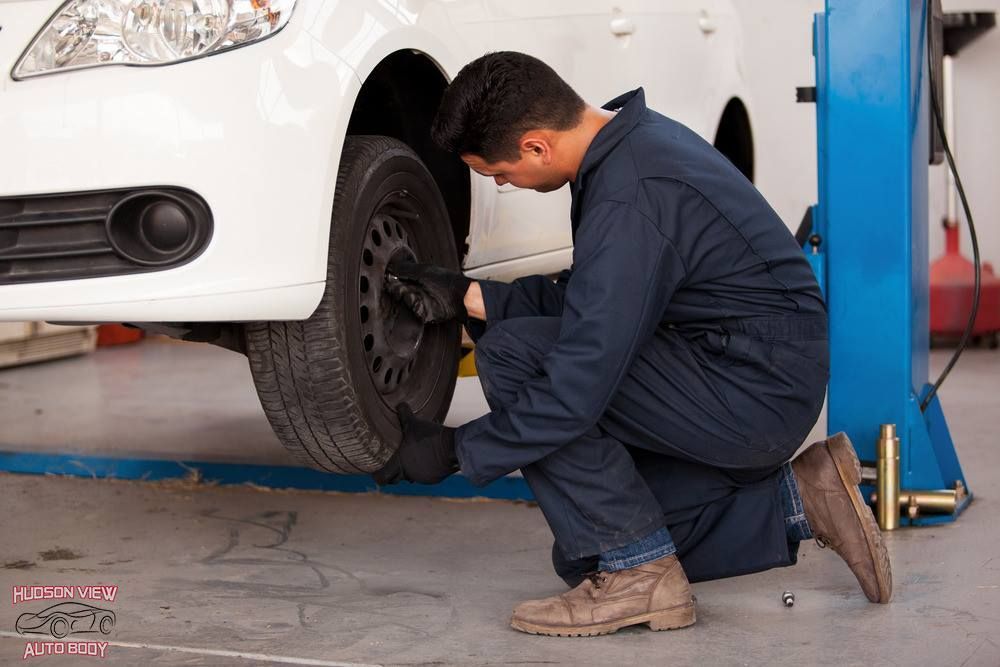
When you bring your vehicle in for tire service in Poughkeepsie, the technician measures tread depth with a gauge and checks for uneven wear patterns that suggest alignment or suspension problems. If you are buying new tires, they remove the old ones, mount the new rubber onto the rims, inflate them to the manufacturer's recommended pressure, and spin-balance each wheel to eliminate vibration at highway speeds.
After the service, your vehicle will handle more predictably and ride smoother over rough pavement. If your old tires were bald or cupped, you will notice improved traction in wet conditions and a quieter cabin at speed. The steering will feel more responsive, and you will not feel the car pulling to one side if the balance was off before. A properly repaired flat holds air without the need for constant reinflation, and new tires restore the grip you had when the vehicle was newer.
The shop stocks a range of tire sizes and brands and can order specialty tires if your vehicle requires a size that is not kept in inventory. If your alignment is off, the technician will recommend that service before installing new tires to prevent premature wear. Valve stems are replaced during installation if they show signs of cracking or leaking.
Common Questions About Tire Work
People often want to know how long their tires will last, whether a flat can be repaired, and when rotation or balancing is necessary.
How do I know if my tires need to be replaced?
If the tread depth is below 3/32 of an inch, you see cords showing through the rubber, or the sidewalls have cracks and bulges, replacement is needed. The technician measures tread depth and inspects for damage during your visit.
What is the difference between balancing and rotation?
Balancing corrects weight distribution on each wheel to prevent vibration, while rotation moves tires to different positions on the vehicle to promote even wear. Both services help your tires last longer and keep the ride smooth.
When can a flat tire be repaired instead of replaced?
If the puncture is in the tread area, smaller than a quarter inch, and the tire still has adequate tread, it can usually be patched. Sidewall damage or large holes require replacement.
What tire brands do you carry?
The shop stocks all-season and performance tires from major manufacturers in the most common sizes for cars, trucks, and SUVs. If you need a specific brand or size, they can order it and install it within a few days.
How often should I rotate my tires?
Most manufacturers recommend rotation every 5,000 to 7,500 miles to prevent uneven wear. The shop in Poughkeepsie can rotate your tires during regular maintenance visits or when you notice irregular tread patterns.
Whether you need a single tire replaced after hitting a pothole or a full set for the winter months ahead, Hudson View Auto Body, Inc. in Poughkeepsie handles the mounting, balancing, and disposal of your old tires.
Tire Services
Improve your vehicle’s handling, increase tire life and drive with safety by checking your tires every month to ensure that they are inflated with the right amount of air pressure.
We offer a wide range of tires for your vehicle. Let our professionals help you find, balance and mount the right tires for your car.
Call or email us and let us help you with your tire services.
Below are some of the tire services that we offer:
- Wheel Alignment
- Tire Mounting
- Tire Balancing
- Tire Rotation
- Tire Inspection
We also carry various tire brands. Here are some of the tire brands that we carry:

Tire Guide and Tips: Understanding your Tires
For example, the number may read P225/70-R15, 89H:
- P = Passenger Tire (LT = Light Truck)
- 225 = Overall width of the tire in millimeters
- 70 = Sidewall height (distance from rim to tread) as a percentage of the tread width (known as aspect ratio)
- R = Tire construction, this one is Radial (also, B = Belted Bias, D = Diagonal Bias)
- 15 = Represents the size of the wheel in inches
- In this example, the tire has the number 89H. This is the weight capacity of the tire. However, in most cases, you will not see this heading on the sidewall.
- A speed rating is sometimes put in front of the R (or B or D). A straight R rating means that it is rated for speeds of up to 100mph. The manufacturer does not recommend this tire for speeds greater than 100 mph. Other speed ratings are: S=112mph, T=118mph, U=124mph, H=130mph, V=149mph, & a Z rated tire is for speeds in excess of 149mph.
- The V and Z rated tires have excellent dry pavement grip/traction but due to their soft rubber compounds, do not have a long life.
- A tread rating indicates how long a tire should last. This figure is written in small letters on the sidewall of your tire. The higher the number, the longer the tire should last. 100 is the basic treadwear rating.
- The traction rating works just like grading – ‘A’ being the best, ‘B’ is good, and ‘C’ is acceptable. This number is also found on the sidewall.
- Temperature ratings work the same – ‘A’ best, ‘B’ good, ‘C’ acceptable. If you drive your car very hard, you want a temperature rating of ‘A’ because a ‘C’ would fail faster under these conditions. Again, look for this number on the sidewall.